

Some common sense of the damper, rotary damper manufacturers for you
Release time:
2022-11-22 09:36
Source:
Rotary Damper The manufacturer believes that the damping force of the viscous damper comes from the silicone oil set in the device. When the piston in the cylinder moves with the movement of the structure, the piston head moves to one end, the silicone oil in the device is squeezed, and a reverse viscous force is generated on the piston. At the same time, the silicone oil flows from the small hole on the piston head to the other end of the piston head, gradually reducing the force on the piston. In the reciprocating motion of the piston, the liquid plays the role of viscous damping and dissipates the seismic wind-induced vibration energy, thus damping and controlling the structure.
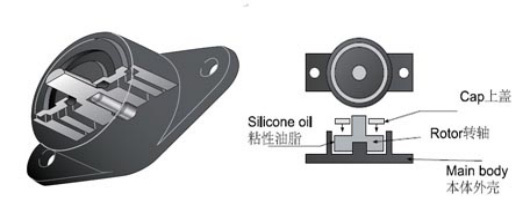
Rotary Damper Manufacturer believes that Traditionally, the design adheres to the "hard resistance" concept at the expense of plastic damage of structural components, and adopts measures such as optimizing the characteristic geometry of key components and increasing the strength of component materials to improve the seismic bearing capacity of the structure. The occurrence of earthquakes is random and destructive. Therefore, the traditional design is not only difficult to ensure the safety of the building structure and life and property, but also may greatly increase the construction cost. Structural energy consumption is also called energy consumption. The mechanism is to install an energy dissipator at the interface connection of a specific component to convert the mechanical energy input by ground motion into heat energy that can be evenly dissipated, thereby reducing the structural vibration response. Alternatively, the original structure and the attachment in the new structure can share the vibration as the main structure and the sub-structure, thereby obtaining tuning to control the vibration response within the desired value.
Rotary Damper The manufacturer believes that when adopts the energy dissipation method, the structure can obtain sufficient initial stiffness under the action of small earthquake or wind vibration and maintain the elastic state. Under the action of high-rise earthquake or wind vibration, when the lateral deformation of the structure has not yet begun to increase, the energy dissipation device can enter the inelastic state before the structure, thus preventing the load-bearing members of the structure from entering the inelastic state.
Rotary Damper The manufacturer considers the viscous damper to be a speed dependent damper. At present, it is widely used in civil engineering field, such as single rod viscous damper, viscous damping wall viscous damper and so on. Two kinds of dampers have been widely used in the vibration control of building structures.
Rotary Damper Manufacturer believes that the construction of damper can refer to the requirements of relevant standards, and the arrangement of energy dissipation dampers in the structure should follow:
(1) Energy dissipation components should be arranged along the main axis of the structure as required, and the dynamic characteristics of the structure in the two main axis directions should be similar to form a unified and reasonable structural system.
(2) The energy dissipation part is arranged at the position with large deformation or speed. Rotary damper manufacturer believes that when is connected by wall, the displacement type energy dissipator can be arranged near the column edge first, and the speed type energy dissipator can be arranged at the mid-span position first.
(3) The arrangement of energy dissipation components should not cause weak components or weak layers in the structure, while ensuring uniform rigidity of the structure along the height direction.
(4) The setting of the energy dissipator shall be convenient for inspection, maintenance and replacement, and the design documents shall indicate the requirements for the environment, inspection and maintenance of the energy dissipator. Under the use environment of energy dissipators, the main mechanical performance indicators meet the relevant provisions of the current national and industrial standards.
(5) Rotary Damper The manufacturer believes that should adopt an energy dissipator structure with interlayer support, cantilever wall and connecting beam, and arrange the number of energy dissipators. The number of floors of multi-storey buildings should not be less than 1/2 of the total number of floors, and high-rise buildings should not be less than 1/3. In addition, in the floors where energy dissipators are arranged, the sum of the actual Z output of energy dissipators is not less than 15% of the total shear force of the floors, and not less than half of the floors.
Related News
Message
Professional service team answers
Contact Us
Contact: Miss Peng
Phone: +86 13537499713
Tel: +86 0769-87769161
Fax: +86 0769-87681161
Email: sales@longji-lf.com, zxm@longji-lf.com
Address: Room 201, Building 2,and Room 301, Building 4, No. 7 Jinming North Road, Xiegang Town, Dongguan City,

Scan consultation