

Some knowledge points of the damper, the manufacturer of the rotary damper tells you
Release time:
2022-12-13 13:17
Source:
Rotary Damper The manufacturer believes that the damper is a device that provides motion resistance and consumes motion energy. Using damping to absorb energy is not new. Various dampers (or shock absorbers) have been used to reduce vibration and dissipate energy in the aerospace, aviation, military, automotive and other industries. Since the 1970 s, people have gradually applied these technologies to structural projects such as buildings, bridges, and railways, and they have developed very rapidly. In particular, the hydraulic viscous damper with a history of more than 50 years has undergone a long process of a large number of experiments, strict review and repeated demonstration, especially seismic tests, before it was accepted by American structural engineering.
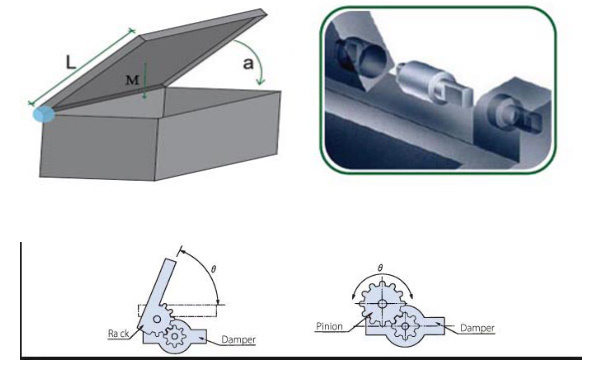
Rotary Damper The manufacturer believes that the damper is a device that can quickly stop the movable part of the instrument in a stable deflection position. In seismic instruments, dampers are used to absorb the natural vibration energy of a vibrating system, and their damping force is generally proportional to the speed of the vibrating system. There are three main types of liquid dampers, gas dampers and electromagnetic dampers. The shock absorber plays an important role in compensating the small friction and air resistance in the vibration pickup pendulum system and improving the frequency response.
Rotary Damper Manufacturer believes that the basic content of energy dissipation design and calculation is to estimate the displacement of the structure, compare it with the displacement of the structure without energy dissipation and damping, calculate the required additional damping, select the number and arrangement of energy dissipation and damping components and the damping that can be provided, design the corresponding energy dissipation and damping components, and then analyze the energy dissipation and damping system as a whole, confirm whether the requirements of displacement control are met.
Rotary Damper Manufacturer believes that the main problems to be solved in energy dissipation design include: selection of energy dissipation devices and energy dissipation components, distribution and quantity of energy dissipation components in the structure, estimation of damping ratio attached to the structure by energy dissipation devices, displacement calculation of energy dissipation system under rare earthquakes, connection structure between energy dissipation components and main structure and its additional functions, etc.
When the wind vibration comfort of high-rise building structures cannot meet the functional requirements, wind vibration control design should be carried out to reduce the wind vibration effect of the structure. The manufacturer of
rotary damper believes that when the high-rise structure is controlled by wind vibration, appropriate energy dissipators can be set according to the expected structural displacement and acceleration control requirements under wind load. The energy dissipator should adopt speed-dependent energy dissipator (viscous energy dissipator and viscoelastic energy dissipator), frequency-modulated energy dissipator (frequency-modulated mass energy dissipator and frequency-modulated liquid energy dissipator), or active-passive hybrid frequency-modulated mass energy dissipator.
Rotary DamperManufacturer believes that FM energy dissipator includes FM mass energy dissipator and FM liquid energy dissipator. The FM energy dissipator absorbs and dissipates structural vibration energy by resonating with the main structure. The wind-induced vibration control effect of the FM dissipator is achieved by providing additional damping to the controlled vibration modes of the structure. Because the FM energy dissipator can only provide some additional damping, when the main structure itself has a large damping (damping ratio is greater than 3%), the wind vibration control effect of the FM energy dissipator is not obvious. Therefore, the FM energy dissipator is suitable for structures with relatively small damping.
Related News
Structural dampers explained: types, uses, and how to choose the right one
A complete 2026 guide to structural dampers: compare all major types, review U.S. code compliance (ASCE 7-22, IBC 2021), explore real project case studies, and get a clear decision framework for selecting the right damper for your building.
Squeeze film dampers explained: how they work, types, and selection guide
A comprehensive 2026 guide to squeeze film dampers: working principles, configuration types, oil viscosity selection, failure modes, API compliance, and emerging active damper trends for aerospace and industrial turbomachinery engineers.
Spring dampers explained: how to choose the right type for your application
A complete 2026 guide to spring dampers: technical comparison tables for Bilstein, KYB, Monroe and Sachs, failure diagnosis tips, installation costs, and application-specific selection advice for US drivers and engineers.
Silicone dampers for car doors: how to choose and install the right buffer pads
Discover how silicone dampers for car doors reduce noise, protect your vehicle, and outlast rubber alternatives. Compare materials, find vehicle-specific fitment guides, and follow our step-by-step installation tutorial for 2026.
Shock absorbers vs dampers: how to choose the right one for your vehicle
Confused about shock absorbers vs dampers? This 2026 guide covers symptom-based diagnostics, brand comparisons (Bilstein, KYB, Monroe), towing-specific selection, electronic dampers, and real cost breakdowns to help you choose the right ride control components.
Metallic dampers guide: how to choose and install the right type for your system
A complete 2026 guide to metallic dampers: compare BRB, ADAS, TADAS, and lead extrusion types by performance, cost, and US code compliance. Includes installation steps, real project case studies, and a North America buyer's guide for structural engineers and procurement teams.
Message
Professional service team answers
Contact Us
Contact: Miss Peng
Phone: +86 13537499713
Tel: +86 0769-87769161
Fax: +86 0769-87681161
Email: sales@longji-lf.com, zxm@longji-lf.com
Address: Room 201, Building 2,and Room 301, Building 4, No. 7 Jinming North Road, Xiegang Town, Dongguan City,

Scan consultation