

Damping gear: what is the noise of damping gear transmission
Release time:
2020-06-11 13:51
Source:
Generally speaking, damping gear transmission will produce noise in the following two aspects: on the one hand, when the gears mesh, because the gears slide with each other, a force, that is, friction will be generated; at the same time, Its direction will constantly change, and meshing pulses will appear during the collision process, which will generate noise; on the other hand, when the gear vibrates, it often excites the air in the reducer to a certain extent. Because the air itself can expand and compress, when it is affected by vibration, the phenomenon of expansion or compression will naturally occur, and it will also produce sound waves to form noise.
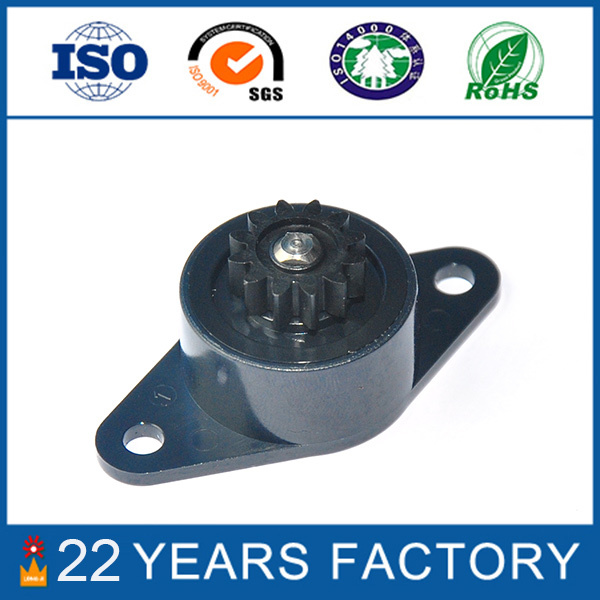
Damping gear Causes of transmission noise
When the gear is driven, it is affected by many different factors, such as assembly accuracy and manufacturing accuracy, so it will be noisy.
1.1 Meshing Impact
When a pair of damping gears mesh, the gear teeth will be subjected to force. In this process, they will definitely be impacted and deformed. However, after the new gear teeth are engaged, the engagement load of the previous gear teeth is reduced to some extent, so that the portion of the gear deformed by the impact is restored to its original shape, and the tangential acceleration is given to the gear body. At the same time, because the original gear teeth changed the original shape after meshing, the new gear teeth could not be in smooth contact with the theoretical tooth profile when meshing, resulting in collision phenomenon, resulting in meshing impulse. When the gear is subjected to impact force, it will certainly produce various vibrations, such as axial and radial and circumferential vibrations, resulting in noise.
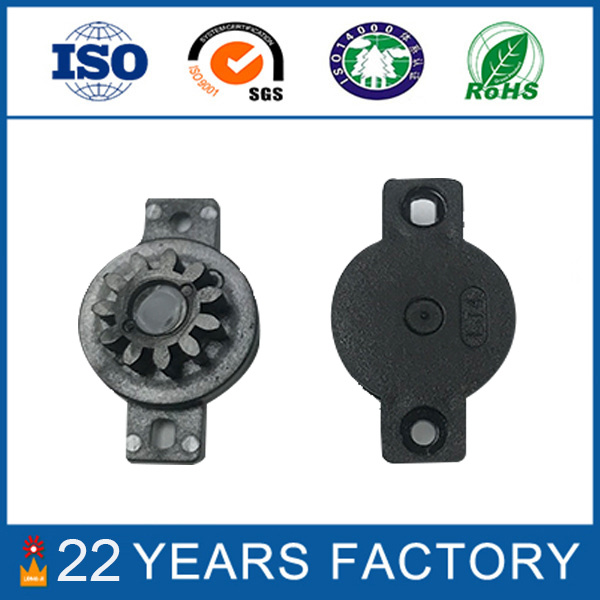
1.2 Pulsating Impact
Involute Damping Gear When driving, the contact points of the gear teeth usually move on the meshing line in sequence. After a series of studies have shown that in the process of gear transmission, the position of the meshing point is constantly changing, so the speed generated by the sliding between the tooth profile on the meshing line will also be different. The meshing start point and the meshing end point are large, and the sliding speed of the joint circle tangent point is zero. In addition, the size and direction of its sliding speed will also change. For these reasons, the friction force will definitely change, resulting in a pitch line impulse. The sliding speed of friction has a direct and close relationship with the size of the pitch line impulse. Therefore, as the gear transmission power increases, the friction of the gear will gradually decrease, and the pulsating impact will gradually increase. When the gear teeth are engaged, the pulsation impact cannot be prevented from occurring. The occurrence of pulsating impact will inevitably cause the gear to vibrate, thereby generating noise.
Related News
Message
Professional service team answers
Contact Us
Contact: Miss Peng
Phone: +86 13537499713
Tel: +86 0769-87769161
Fax: +86 0769-87681161
Email: sales@longji-lf.com, zxm@longji-lf.com
Address: Room 201, Building 2,and Room 301, Building 4, No. 7 Jinming North Road, Xiegang Town, Dongguan City,

Scan consultation