

Rotary dampers: What are the characteristics and working principles of rotary dampers?
Release time:
2020-06-24 14:09
Source:
Rotary dampers are very common in our lives and work. It is suitable for all kinds of mechanical movements that need buffering, relieving friction between equipment and prolonging the service life of products. This article details what a rotary damper is. What are its characteristics, as well as its characteristics and working principle.
Characteristics of the rotary damper
Speed, the torque of the rotary damper changes according to the change of speed. The law of change is: speed increases, torque also increases. As the speed decreases, the torque also decreases. The starting torque is different from the standard torque. Temperature characteristics, the torque of the rotary damper changes according to the change of the operating environment temperature. The law of change is that when the ambient temperature increases, the torque decreases, and when the ambient temperature decreases, the torque increases. This is because when the ambient temperature changes, the viscosity of the viscous oil in the damper also changes. However, when the ambient temperature returns to the normal temperature, the torque will also return to its original value.
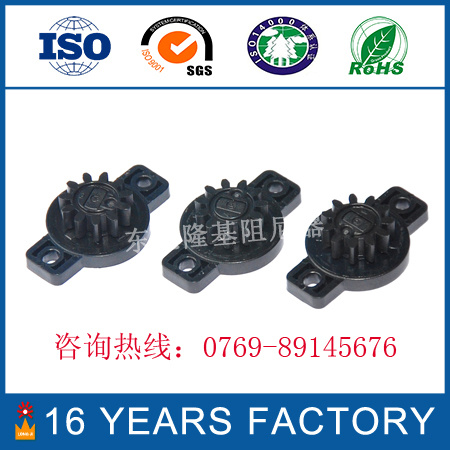
The working principle of the rotary damper
One advantage of the disc brake is that the powder generated by the friction between the friction plate and the brake disc will be quickly thrown out, and the heat will be The brake disc radiates out faster, thereby obtaining better braking performance. Drum brakes are clearly relatively weak in this regard. Due to the fast response and high-frequency braking capabilities of disc brakes, many models use disc brakes in combination with anti-lock braking systems, VSC , traction control systems, etc. to meet the needs of such systems. For these reasons, and in order to obtain a large braking capacity, many cars are equipped with four-wheel brakes. Some models will install a shock absorber on the brake caliper, which can effectively control the noise during braking. This noise mainly comes from the vibration generated by the friction between the brake pad and the brake disc, and the added damper can solve this vibration. The rotary damper uses the brake transmission mechanism to press the brake shoe on the inner brake friction plate to generate braking force, so that the wheels can slow down or stop for a short distance as needed, thereby ensuring driving safety and ensuring reliable parking of the car without automatic sliding. The rotating element of a drum brake is a brake drum and the stationary element is a brake shoe. Its cost is consistent with traditional design.
Related News
Message
Professional service team answers
Contact Us
Contact: Miss Peng
Phone: +86 13537499713
Tel: +86 0769-87769161
Fax: +86 0769-87681161
Email: sales@longji-lf.com, zxm@longji-lf.com
Address: Room 201, Building 2,and Room 301, Building 4, No. 7 Jinming North Road, Xiegang Town, Dongguan City,

Scan consultation