
LF-21B small damping gear
Classification:
Product Description
This type of resistance gear uses the viscosity of damping silicone oil to generate torque, with a wide range of applications, such as on computer chassis panels, car sunroof switches, car audio flip covers, car refrigerator flip covers, car ashtrays, trash can lids, and various electronic appliance flip products, playing a role in shock absorption and buffering.
All dampers produced by our company use imported environmentally friendly raw materials, ensuring stable product performance and high cost-effectiveness.
Product specifications:
| Model | Torque | Damping rotation direction |
| LF-21B-50G | 50-80gf.cm | 360° rotation (bi-directional) |
| LF-21B-100G | 100±20gf.cm | 360° rotation (bi-directional) |
| LF-21B-150G | 150±20gf.cm | 360° rotation (bi-directional) |
Note: 1) The marked torque is the data measured after the damper rotates for 5 turns under conditions of temperature at 23°C and humidity at 80%, with the test rig motor speed at 36 revolutions per minute;
2) Torque customization can be provided by changing the viscosity of the damper grease.
3) Maximum operating temperature range for the damper: -40°C to +90°C.
4) This series of dampers can provide gear customization.
Damper appearance size diagram:
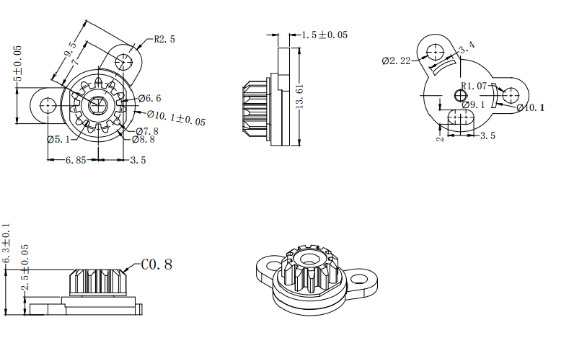
Damper gear parameters
| Module | Number of teeth | Pitch circle | Pressure angle |
| .6 | .11 | .6.6 | .20° |
Damper product materials
| - Shell/Top cover | - Shaft/Gear | - Sealing ring | - Damping oil |
| - PC (Polycarbonate) | - POM (Polyoxymethylene) | - Silicone rubber | - Silicone oil |
- Damper characteristics
- A. Temperature characteristics:
- The torque generated by the damper will change under the influence of environmental temperature. This is because changes in temperature affect the viscosity of damping oil; torque output decreases as temperature increases and increases as temperature decreases. When the temperature returns to normal, torque also returns to its original value.

- B. Speed characteristics:
- The torque of the damper will also change when using different rotational speeds. Generally speaking, as rotational speed increases, torque also increases; as rotational speed decreases, torque decreases accordingly. Additionally, starting torque differs from standard torque.

- A. Gear and rack fit (linear motion of workpiece)

- B. Gear and gear fit (rotational motion of workpiece with angle)

- C. Gear and gear fit (no angle restriction)

- D. Workpiece directly connected to damper rotating shaft

Key words:
Damper
Related Products
Online message
Professional service team answers
Contact Us
Contact: Miss Peng
Phone: +86 13537499713
Tel: +86 0769-87769161
Fax: +86 0769-87681161
Email: sales@longji-lf.com, zxm@longji-lf.com
Address: Room 201, Building 2,and Room 301, Building 4, No. 7 Jinming North Road, Xiegang Town, Dongguan City,

Scan consultation